
Insert a Pivot Table | Drag fields | Sort | Filter | Change Summary Calculation | Two-dimensional Pivot Table
Jump to: Frequently used shortcuts, Work in windows and dialogs, Move and scroll in a sheet or workbook, Enter data on a sheet, Work in cells or the Formula bar, Format and edit data, Select cells, columns, or rows, Work with a selection, Use charts, Sort, filter, and use PivotTable reports, Outline data, The following table provides the. Paste it into an Excel workbook, for use in your own tests. Create an Excel Table. After you paste the sample data into Excel, you can format it as a named Excel table. This will make it easier to sort and filter the data. Watch this short video to see the steps, and there are written instructions on the Creating an Excel Table page.
Pivot tables are one of Excel's most powerful features. A pivot table allows you to extract the significance from a large, detailed data set.
Our data set consists of 213 records and 6 fields. Order ID, Product, Category, Amount, Date and Country.
Insert a Pivot Table
To insert a pivot table, execute the following steps.
1. Click any single cell inside the data set.
2. On the Insert tab, in the Tables group, click PivotTable.
The following dialog box appears. Excel automatically selects the data for you. The default location for a new pivot table is New Worksheet.
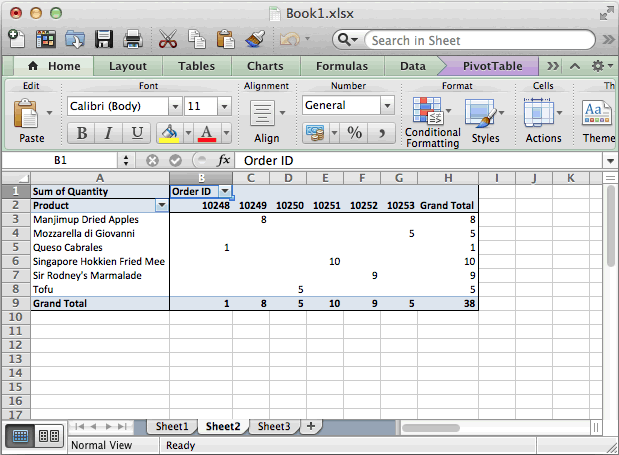
3. Click OK.
Drag fields
The PivotTable Fields pane appears. To get the total amount exported of each product, drag the following fields to the different areas.
1. Product field to the Rows area.
2. Crafting your story with a website. Amount field to the Values area.
3. Country field to the Filters area.
Below you can find the pivot table. Bananas are our main export product. That's how easy pivot tables can be!
Sort
To get Banana at the top of the list, sort the pivot table.
1. Click any cell inside the Sum of Amount column.
2. Right click and click on Sort, Sort Largest to Smallest.
Result.
Filter
Because we added the Country field to the Filters area, we can filter this pivot table by Country. For example, which products do we export the most to France?
1. Click the filter drop-down and select France.
Result. Apples are our main export product to France.
Note: you can use the standard filter (triangle next to Row Labels) to only show the amounts of specific products.
Change Summary Calculation
By default, Excel summarizes your data by either summing or counting the items. To change the type of calculation that you want to use, execute the following steps.
1. Click any cell inside the Sum of Amount column.
2. Right click and click on Value Field Settings.
3. Choose the type of calculation you want to use. For example, click Count.
Best mail app for mac and iphone xr. 4. Click OK.
Result. 16 out of the 28 orders to France were 'Apple' orders.
Ssd testing tool for mac. Disk Speed Test is an easy to use tool to quickly measure and certify your disk performance for working with high quality video! Simply click the start button and Disk Speed Test will write test your disk using large blocks of data, and then display the result. #2: Intel SSD Toolbox – Available for Mac & PC This tool is a drive management software which will allow the user to monitor estimated drive life remaining, drive health and even S.M.A.R.T attributes. The SSD Toolbox is capable of running quick as well as full diagnostic scans in order to test the read and write functionality of an Intel SSD. If you feel your Mac hard drive (or solid-state drive) is slow to respond, it’s good practice to test its write/read speed and benchmark with the industry standard. You’ll love this free app made by Blackmagic. It’s an amazing yet simple-to-use app that allows you to quickly benchmark and certify your Mac drive performance. Disk Speed Test is an easy SSD Test tool to use with your Mac that can use to measure and certify your disk quickly. Starting the test with a simple click is easy. Disk Speed Test will write test data your disk using large blocks of data and then display the result. It permits you to own a trash pickup that may be triggered at regular intervals of your time. Victimization TRIM practicality, one will optimize the performance of AN Intel SSD. One is in a position to induce a proactive notification of recent Intel SSD tool chest and might update the computer code on a supported Intel SSD. 6.Disk Utility (mac).
Two-dimensional Pivot Table
If you drag a field to the Rows area and Columns area, you can create a two-dimensional pivot table. First, insert a pivot table. Next, to get the total amount exported to each country, of each product, drag the following fields to the different areas.
1. Country field to the Rows area.
2. Product field to the Columns area.
3. Amount field to the Values area.
4. Category field to the Filters area.
Below you can find the two-dimensional pivot table.
To easily compare these numbers, create a pivot chart and apply a filter. Maybe this is one step too far for you at this stage, but it shows you one of the many other powerful pivot table features Excel has to offer.
Excel created pivot tables to improve upon its convoluted, weak reporting features (which are still available). The pivot table is actually a collection of tools that Excel uses to help you create better reports from complex, multi-file spreadsheet data. You filter, sort, reorganize, calculate, and summarize your spreadsheet databases, then extract specific information into a report.
For example, your spreadsheet may contain 25 field columns, but you only need four of these fields for your report. The Pivot Table tools allow you to sift that data in, literally, seconds—a huge improvement over Excel’s previous reporting capabilities.
To make it easier for you to practice the tasks we’re about to describe, we’ve created a downloadable Excel workbook with all the data we use in this article.
downloadIf you’re not downloading the workbook, open our article, Excel databases: Creating relational tables, and follow the instructions to create a sample relational database.
Single “flat-file” Pivot Table reports
Pivot Tables are the “defined as tables” spreadsheets that the Pivot Table tools use to create custom reports for both flat-file and multi-file (relational) databases. This powerful function, which includes some very user-friendly filtering features, is a vast topic that cannot be covered adequately in a single article. Therefore, this article addresses the single “flat file” Pivot Table reports. We'll follow up with coverage of the multi-file “relational” Pivot Table reports.
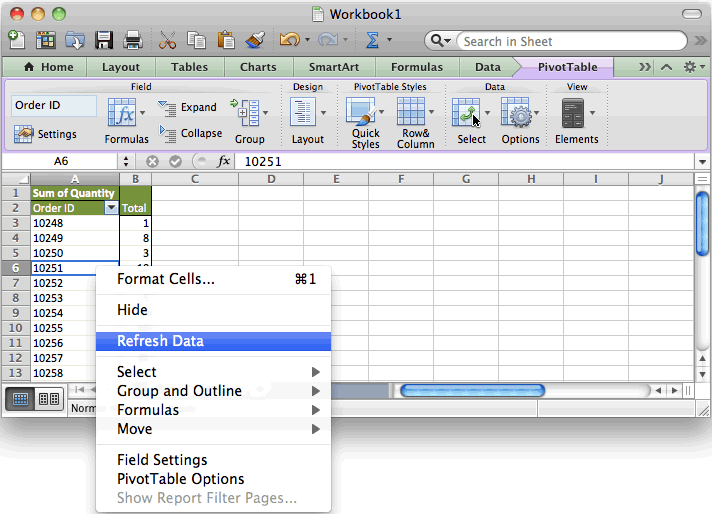
1. Open the database file, then click the VIOLATIONS tab. Place your cursor on column C - Violation Fee. Click the down arrow (right side), choose Sort Smallest to Largest, and click OK.
2. Click the arrow again, select Number Filters > Greater Than.
3. In the Custom AutoFilter dialog window, the field name Violation Fee is displayed under the prompt that says Show Rows Where—Violation Fee: is Greater Than (displays in the first Input box). Click the down arrow beside the second Input box, and select $200.00 from the dropdown list.
4. Click the Design/Table Tools tab (only visible when the table is active). Click the Summarize With Pivot Table button in the Tools group.
5. In the Create Pivot Table dialog window, enter the current table–VIOLATIONS–in the Table Range field box.
6. In the next field box: Choose Where You Want the Pivot Table Report Placed, click the New Worksheet circle, and then click OK.
7. Notice the Pivot Table Fields panel on the right.
Excel displays the Pivot Table Fields list with a message helper box that says: 'To build a report, choose fields from the Pivot Table field list.'
8. For this first report, click the check box for these four fields: License Number, Violation Type, Violation Fee, and Violation Date. Note that Excel builds the report and summarizes the Number fields as you type.
Note: Notice the options at the bottom of this panel: Filters, Columns, Rows, and Values. Click the arrows to open the field boxes under Rows and Values. Note the options provided for each field. We'll cover these features in a future installment.
9. Excel creates a beautiful report sorted by the Drivers’ License Numbers, with the Violation Types sorted alphabetically by Type beneath each License Number, with the fees recorded beside each Violation Type, and then subtotaled by License Number with a Grand Total at the bottom. All you had to do was click the checkboxes beside the fields you wanted in this report, and Excel did the rest. Amazing!
So the report is finished, you hand it to your client, and she says, “I need to see the number of Points that each driver has accrued.' No problem. Adding more fields to the Pivot Table report is as simple as clicking another checkbox.
10. Place your cursor anywhere on the current report to activate the Pivot Table Fields panel.
11. Click the checkbox on the field Points.
12. Note the report changes instantly. The Points are listed beside each violation. Excel sums the Points by License Number with a Grand Total at the bottom, and this does not change or affect the previous totals of the Violation Fees.
13. Also notice the tab additions to the Ribbon menu: Pivot Table Tools: Analyze & Design. All of the above is available under the Analyze tab, plus Pivot Charts and Recommended Pivot Tables.
14. Click the Recommended Pivot Tables button. Excel provides an additional seven suggested reports based on the fields in this table. If you prefer one of these other reports, just select it, and then click OK.
15. Click the Design tab, and the Ribbon menu changes to reflect the Design menu.
16. The first four buttons in the Layout Group (followed by a submenu of additional options under each selection) provide more features that you can customize. Click through each item to see how your selections affect your report. Note that the current Report Layout is called the Compact form.
Subtotals: Do Not Show Subtotals, Show All Subtotals at Bottom of Group, Show All Subtotals at Top of Group, Include Filtered Items in Totals
Grand Totals: Off for Rows and Columns, On for Rows and Columns, On for Rows Only,
On for Columns Only
Report Layout: Show In Compact Form, Show In Outline Form, Show In Tabular Form,
Repeat All Item Labels, Do Not Repeat Item Labels
Blank Rows: Insert Blank Line After Each Item, Delete Blank Line After Each Item
17. Check the buttons Row Headers, Column Headers, and Banded Rows in the Pivot Table Style Options Group. Headers are necessary to read the reports accurately. Banded Rows mean the table is highlighted or colored on every other row, to make the data in the table easier to read.
18. Next, move over to the Pivot Table Styles Group. Click the small down arrow to view a submenu of many colorful Table Styles. Click once on the Style that fits your project, and it changes instantly. Experiment with several different styles to see how colors and formatting can significantly change your table.
19. Notice the last two menu options on the Pivot Table Styles submenu:Clear and New PivotTable Style. Select the latter, and the New Pivot Table Style dialog window opens with dozens of Formatting features to help you design your own custom Styles.
20. Double-click the spreadsheet tab at the bottom and name your report, then save your file.
Tip: You can change the layout of the Pivot Table Fields panel if the current layout is unsatisfactory. Just click the arrow beside the gear box and choose one of the five different layouts. You can also modify the Task Pane options: Move, Size, or Close. Click the arrow beside the X, then click one of these three options.
Note: Because Excel is so popular, many third-party vendors have created a number of Add In programs such as Tool Kits, Report Generators, Graphic Effects plug-ins, and independent programs that perform a variety of functions. Click File > Options > Add-Ins to view a list of the Add-In applications already installed, then select one of these applications and play around with the features it offers. You may find a valuable tool that you can’t live without.
More from MSI Gaming Australia
Excel For Apple Mac Tabular View Vs Outline Pivot Tables
Join the newsletter!